
Rising dramatically above the vast plains of East Africa, its summit often crowned with ice and snow, Mount Kilimanjaro has long fascinated explorers, writers, and adventurers. For anyone drawn to Earth’s most remarkable landscapes, one question naturally arises: where is Mount Kilimanjaro located?
This legendary peak is far more than a geological feature. It is a powerful symbol of Africa’s natural beauty and one of the most awe-inspiring mountains on the planet. Whether you are a climber planning an expedition or a curious traveler exploring world geography, Kilimanjaro offers a story worth discovering in full.
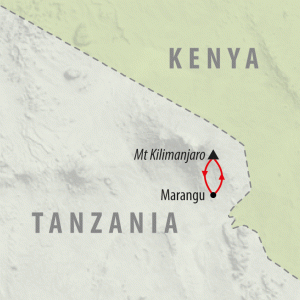
If you are asking where Kilimanjaro is located, the answer lies in northeastern Tanzania, in East Africa, just south of the equator. Its coordinates are approximately 3.067°S latitude and 37.356°E longitude.
A common question is whether Kilimanjaro is in Kenya or Tanzania. While it is very close to the Kenya–Tanzania border and often photographed from Kenya’s Amboseli National Park—the entire mountain, including its summit, lies fully within Tanzania.
The mountain is part of Kilimanjaro National Park, a UNESCO World Heritage Site covering more than 650 square kilometers.
Because it sits near the equator yet rises to extreme heights, Kilimanjaro creates its own climate system. Tropical at its base and glacial at its peak, it is the world’s tallest free-standing mountain, rising abruptly from surrounding savanna.
On any map of Africa, Kilimanjaro stands out in northeastern Tanzania near the Kenyan border. It rises alone, without any surrounding mountain range, making it easy to identify on satellite or physical maps.
Key nearby locations include:
The mountain lies roughly 320 km south of the equator and about 280 km from the Indian Ocean coastline.
Mount Kilimanjaro is the highest mountain in Africa. Its summit, Uhuru Peak, reaches 5,895 meters (19,341 feet) above sea level.
Because it rises independently from the surrounding plains, its total vertical rise from base to summit is nearly 5,000 meters making it one of the most prominent mountains on Earth.
Kilimanjaro is also part of the famous Seven Summits, representing Africa’s highest peak in the challenge of climbing the tallest mountain on each continent.
Despite its height, it is considered a non-technical trekking mountain, meaning no ropes or advanced climbing equipment are required under normal conditions.
Kilimanjaro is a stratovolcano formed through volcanic activity linked to the East African Rift Valley, where tectonic plates are slowly pulling apart.
It consists of three volcanic cones:
Kibo is dormant, not extinct. While it has not erupted in modern history, volcanic gases still escape through vents near its crater, reminding visitors of its powerful geological origins.
Climbing Kilimanjaro is like traveling from the equator to the Arctic in a few days. The mountain features five distinct ecological zones:
Fertile farmland surrounding the base, cultivated by the Chagga people. Coffee, bananas, and maize thrive here.
Dense tropical forest filled with moss, giant trees, monkeys, and exotic birds.
A surreal landscape of giant lobelias and groundsels adapted to cold nights and strong sunlight.
Dry, rocky terrain with extreme temperature changes and very little vegetation.
A frozen, oxygen-poor environment with glaciers, ice fields, and harsh winds.
Most climbers arrive through Kilimanjaro International Airport (JRO), located between Moshi and Arusha. It is served by several international airlines.
Most travelers need a Tanzanian tourist visa, available online or on arrival. A valid passport (minimum six months) is required.
Moshi is the main staging point for climbers, located at the southern base of the mountain. The drive to park gates typically takes 45 minutes to 2 hours.
Several established routes lead to the summit:
Most routes converge near the summit via steep volcanic scree before reaching Uhuru Peak.
Compared to Mount Everest, Kilimanjaro is far less technical:
However, altitude sickness remains a serious challenge and the leading cause of unsuccessful summit attempts.
The best climbing seasons are:
Avoid heavy rainy periods:
Altitude sickness is the biggest obstacle. Successful climbers rely on:
Many visitors combine the climb with safari adventures in northern Tanzania:
Kilimanjaro’s famous ice cap is shrinking rapidly. Since the early 1900s, more than 80% of its glaciers have disappeared due to rising temperatures and changing weather patterns.
Scientists warn that these glaciers may vanish entirely within decades, making the mountain’s icy summit a fading natural wonder.
Summit night is the most demanding part of the climb. Climbers begin around midnight, trekking slowly through darkness and freezing temperatures toward the crater rim.
As the sun rises over Africa, the final steps lead to Uhuru Peak, the highest point on the continent. Standing there, above the clouds, marks the end of an unforgettable physical and emotional journey.
Mount Kilimanjaro is not just a point on a map it is a living landscape shaped by volcanoes, climate, and human history. From rainforest to glacier, from farmland to frozen summit, it represents one of the most dramatic natural transitions on Earth.
Whether you are planning a climb or simply exploring its story, Kilimanjaro stands as Africa’s most iconic peak challenging, inspiring, and unforgettable.

